Tag Archives: Snowy River

Exploring Mt Stilwell. A short stroll in Australia’s Snowy Mountains.

by Glenn Burns

Mt Stilwell (2054 m) is, for me, probably one of the best short walks in Kosciuszko National Park.  At only 1.8 kilometres from Charlotte Pass, on a clear day, it gives unsurpassed views of the Snowy River valley, the peaks of the Main Range and in season, brilliant wildflower displays.

A bonus of the Stilwell hike is that it is ignored by most of the walking fraternity.  Out of the summer school holiday period you will have this part of the park to yourself.  It’s Kossie or bust for most hikers, trail runners and, in recent years, flocks of mountain bikers, all heading for Rawsons Pass and Mt Kosciuszko.

But for those of us with more modest ambitions and time to spare, one can have a thoroughly enjoyable ramble to the top of Stilwell.  And, should you have time, you can explore the extensive alpine meadows of upper Wrights Creek and Merritts Creek, duck across to nearby Little Stilwell, check out the ruins of the Stilwell Restaurant (aka the Ramshead Restaurant) or maybe head off along Kangaroo Ridge. Endless possibilities for the enterprising bushwalker.
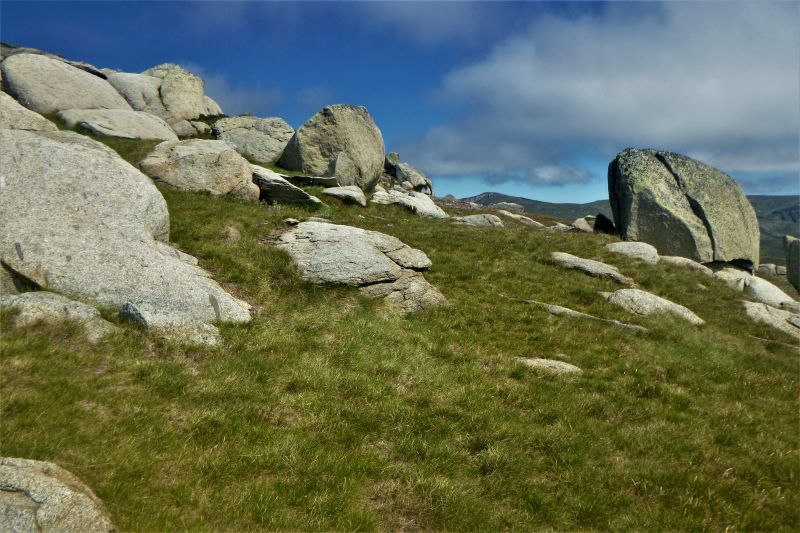
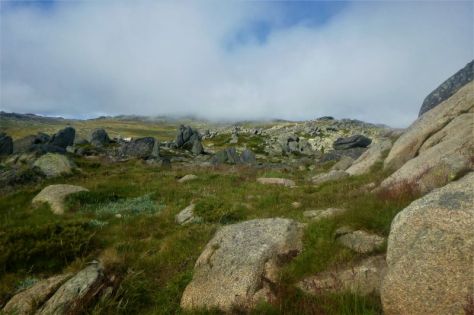
Boulders onKangaroo Ridge. Kosciuszko National Park
Boulders and meadows on Kangaroo Ridge

Our fifteen kilometre summer ramble would take us to Stilwell Trig, thence off-track, contouring along the eastern flanks of Kangaroo Ridge.  Followed by a gentle overland descent towards the Merritts Creek crossing on the Summit Walk from Charlotte Pass to Mt Kosciuszko.  From here it’s a short hop over the Snowy River then uphill to Seamans Hut.  The return trip is downhill along the Summit Walk to Charlotte Pass.

Map showing Mt Stilwell to Seamans Hut hike
Map of Mt Stilwell hike
Based on map: Perisher 1: 25 000

And so, soon after 9 am on a blustery summer’s day, I set off with my ever keen walking companions, Neralie, Chris, Garry and Joe. Stilwell bound.  Another cool 10O C but with the monotonously regular north-westerly idling along.  Ideal walking conditions in my book.

From Charlotte Pass the track climbs through a belt of snow gum woodland to the rusting relics of Australia’s first mechanical ski ‘hoist’. 

Snow gum wodland at start of Mt Stilwell walk. Kosciuszko National Park.
Snow gum woodland at start of Mt Stilwell walk
The Pulpit Ski Hoist

In 1938, the New South Wales Government Tourist Board (NSWGTB) built Australia’s first long ski tow from Charlotte Village to Kangaroo Ridge.  It resembled a modern T-bar with steel cables suspended from wooden posts.

Way back in 1937-1938 it was a difficult build.  The long poles for seven A frame towers were cut in Wilsons Valley and had to be carted and then assembled on a very steep slope.  The wooden towers supported the heavy steel cable to which were attached non-OHS compliant J-bars for the skiers to hang on to.

But it was a very welcome addition to Australia’s skiing scene.   Although it had a few issues.  Rick Walkom in his wonderful book ‘Skiing off The Roof’ has this description:

Skiers experienced plenty of lengthy stoppages.  The hangers travelled at no more than walking pace, and the build up of ice often caused derailments.  Sometimes the J-bars would get caught up in the rocks or, worse still, the heavy hangers would fall off the cable.  A veritable army of skiers was needed to lift the cable back onto the pulleys.’   All part of the fun.

Relics of Old Pulpit Chairlift. Kangaroo Ridge. Kosciuszko National Park.
Relics of old Pulpit Chairlift. Kangaroo Ridge. The NPWS removed the roof and cladding.

Some 600 metres further on is the Charlotte Village to Kangaroo Ridge Triple Chairlift, which does not operate in summer.  Here, at 1920 metres, is a Cortan steel lookout with unimpeded views to the Main Range and Mt Stilwell, capped by its trig tower.  An information board acknowledges indigenous links to Kosciuszko:
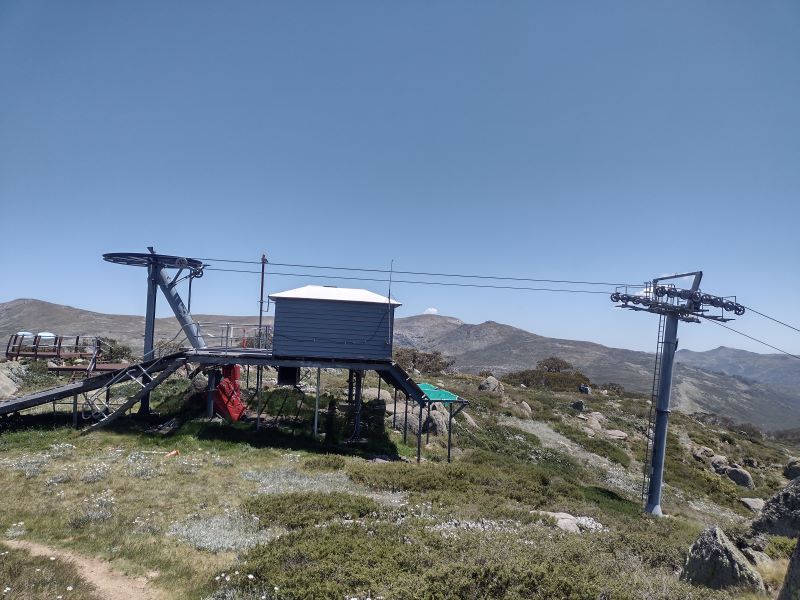
Kangaroo Ridge to Charlotte Village Triple Lift. Kosciuszko National Park.
Triple Lift from Charlotte Pass Village to Kangaroo Ridge

The local rainmaker, Dyilligamberra, represents all the rain, snow and water from these mountains to the sea.  His relatives make wind and cloud.  They are very powerful, so we show our respect by going quietly in the mountains.’  Rod Mason. Aboriginal Education Officer.

The lookout platform provides a brilliant skyline view of the Main Range.  On a clear day like this, all the high peaks are visible and you can identify them from the labelled panorama on the information board.  From east to west (L to R): North Rams Head, Mt Kosciuszko, Mt Clarke, Mt Townsend, Mt Lee, Carruthers Peak, Mt Twynam, Mt Anton and Mt Tate.  A Who’s Who of Australia’s highest peaks.

Main Range panorama

Tall alpine herbfield

The tall alpine herbfields are the most extensive of all Kosciuszko’s alpine plant communities and are found on well-drained and deeper soils. These herbfields occur on a variety of bedrock types, suggesting that lithology has a negligible influence on location.  Here, the bedrock is Mowambah granodiorite which erodes to form sandy and well-drained soils.  Obviously perfect for wildflower meadows.

Tall alpine herbfields. Kosciuszko National Park.
Crossing tall alpine herbfields under Mt Stilwell

This plant community is the most diverse of all the alpine vegetation types in terms of number of species.  Showy wildflowers grow in a matrix of snow grasses (Poa caespitosa) and sedges (Carex sp).  Technically, it is an association dominated by the genera Celmisia (daisies) and Poa.

As we were walking in late summer the wildflowers were well past their prime.  Later the same year in mid-December the display was spectacular.

Meadow of silver snow daisies. Celmisia astelifolia. Mt stilwell. Kosciuszko National Park.
Meadow of silver snow daisies (Celmisia astelifolia). Mt Stilwell.

Here is my mid-December list:  silver snow daisy (Celmisia astelifolia), Australian bluebells (Wahlenbergia spp), star buttercups (Ranunculus spp), bidgee widgee (Acaena anserinifolia), Australian gentians (Gentiana spp), eyebrights (Euphrasia collina spp), billy buttons (Craspedia uniflora), spoon daisy (Brachyscome sp), yellow Kunzea (Kunzea muelleri), tall rice-flower (Pimelea ligustrina), alpine mint-bush (Prostanthera sp), alpine Stackhousia (Stackhousia pulvinaris), mountain celery (Aciphylla glacialis) trigger plant (Stylidium montanum), purple alpine Hovea (Hovea montana), and violets (Viola betonicifolia).
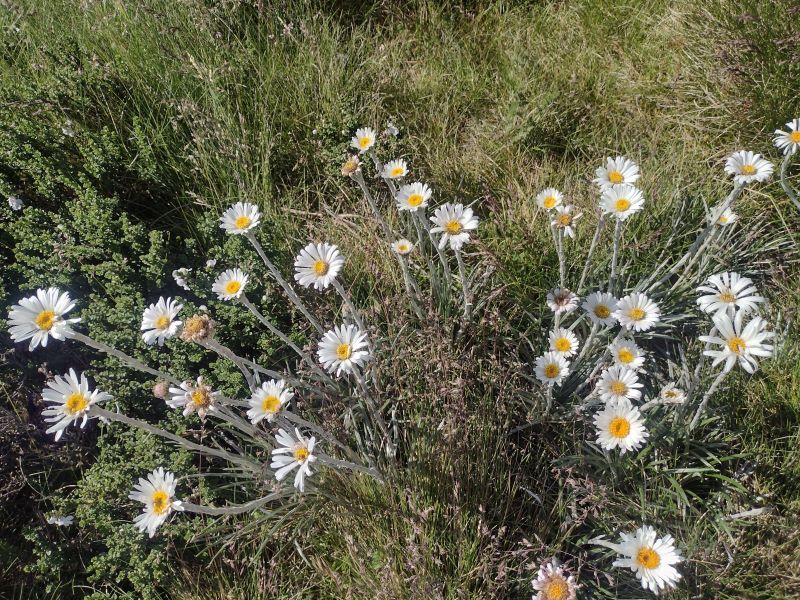
Alpine wildflower. Silver snow daisy. Kosciuszko National Park.
Silver snow daisy. Celmisia astelifolia.
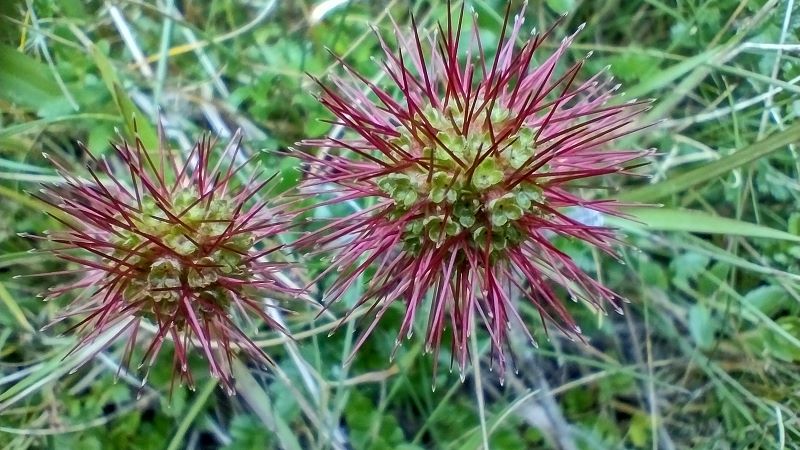
Alpine wildflower. Bidgee widgee. Kosciuszko National Park.
Bidgee widgee. Acaena anserinifolia. A pesky prickly plant if it attaches to your socks.
Alpine wildflower. Mueller's snow-gentian. Kosciuszko National Park.
Gentianella muelleriana spp alpestris. An endemic to Kosciuszko.
Alpine wildflower. Mountain celery. Kosciuszko National Park.
Mountain celery. Aciphylla glacialis. Recovering well from overgrazing.
Alpine wildflower, Eyebright. Kosciuszko National Park.
Eyebright. Euphrasia collina spp glacialis. Endemic to Kosciuszko.
Alpine wildflower. Alpine Stackhousia. Kosciuszko National Park.
Alpine Stackhousia. Stackhousia pulvinaris. Likes moist areas.
Alpine wildflowers. Trigger plant. Kosciuszko National Park.
Alpine trigger plant. Stylidium montanum. The trigger is a hammer shaped column which springs closed on the backs of foraging insects.

Alpine wildflower guide for your rucksack
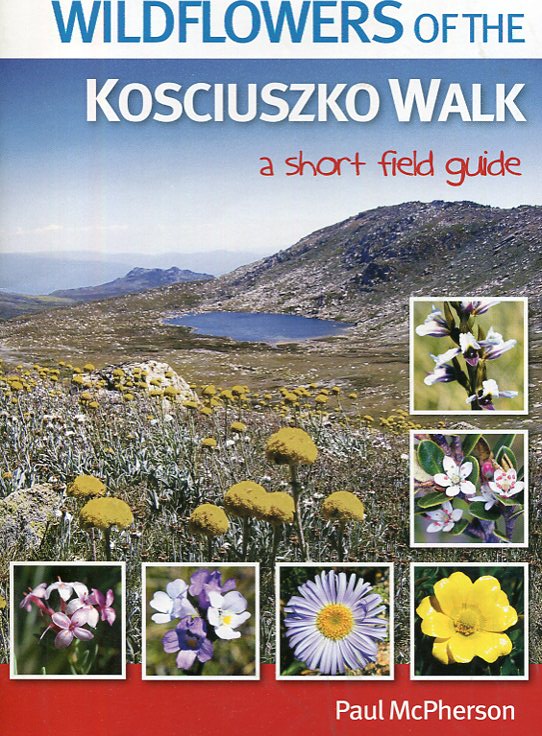
Alpine wildflower guide. Small enough to go in your day pack. 15 cm x 21 cm.

A bushwalkers’ pad climbs up through these meadows and is very exposed.  It was windy, the UV index was off the scale but the walking was brilliant. We crossed meadows, seepages and weaved in and out of the outcropping granodiorite boulders.
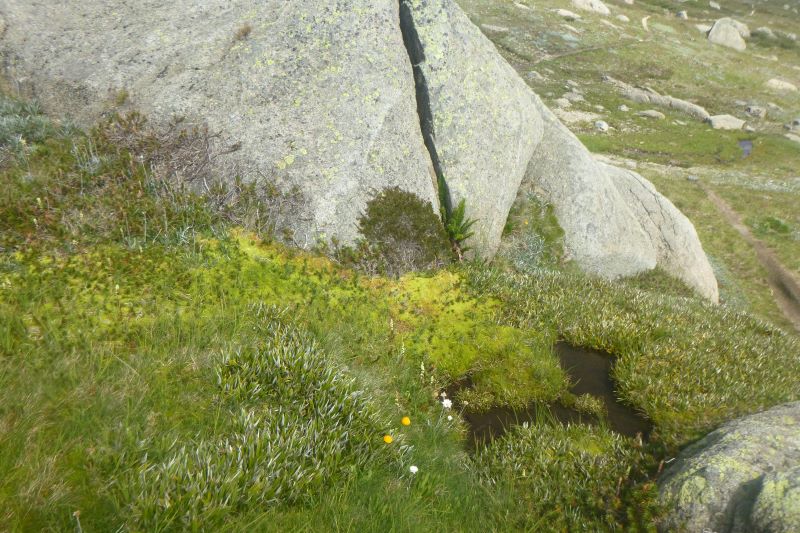
Seepages and boulders on the old bushwalkers’ pad to summit of Mt Stilwell.
Xenoliths

If you keep your eyes open, you will see large patches of foreign rock or minerals embedded in the granodiorite.  These are Xenoliths. There is some argumentation over the origins of Xenoliths (Foreign Rock).   At its simplest, it is thought they are fragments of existing country rock caught in the molten magma as it cools.
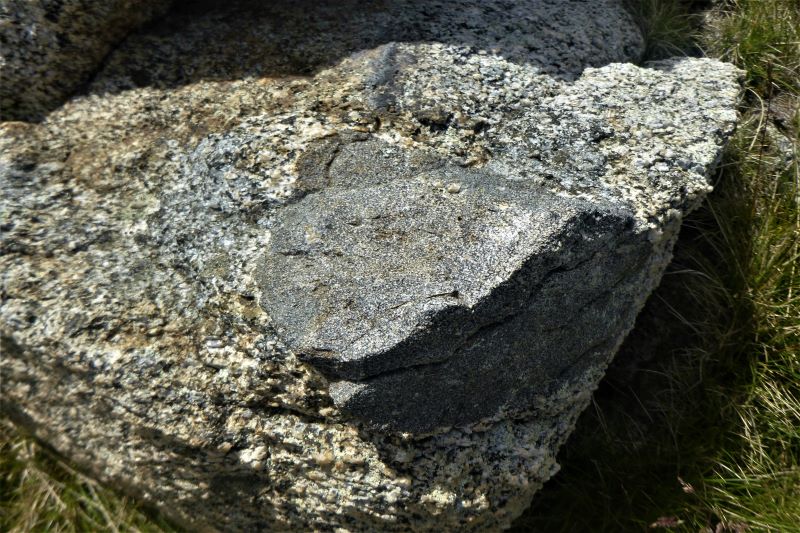
Xenolith in Mowambah granodiorite. Mt Stilwell. Kosciuszko National Park
Xenolith in Mowambah granodiorite. Mt Stilwell

As usual, I couldn’t gee up much interest in Xenolith spotting, so we pushed on to the summit.  It is topped by a trig tower atop a spine of heavily frost-shattered rock.  With the summit photo shoot completed, we retreated to the lee of the summit.  To a pleasant sunny spot that Garry and Neralie had secured for our morning tea, out of the wind.
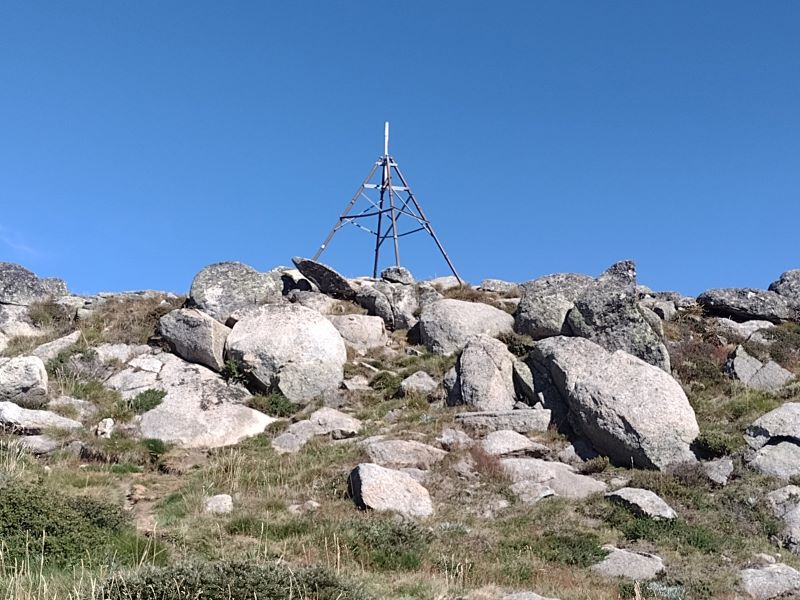
Summit trig station. Mt Stilwell. Kosciuszko National Park.
Summit trig station. Mt Stilwell

Frank Leslie Stillwell

It is likely that Mt Stilwell was named after Frank Leslie Stillwell (1888 – 1963).

Stillwell (note spelling shift) was an Australian geologist and Antarctic Expeditioner (1911-1914).  He served under the famous Douglas Mawson. Stillwell’s later career took him to the mining provinces of Broken Hill and Kalgoorlie.
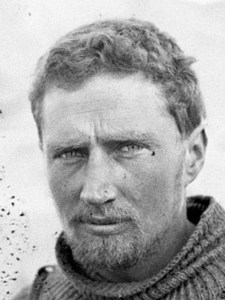
Frank Leslie Stillwell.
Frank Leslie Stillwell. Antarctic Expeditioner & Geologist.

On the eastern side of Mt Stilwell, just below the summit, if you look carefully you should be able to find a massive vein of milky quartz embedded in a boulder of Mowambah granodiorite.  Milky quartz is a very common mineral.  I have sat here many times for morning tea, but 2024 was the first time I clocked this huge outcrop.

Sill of milky quartz. Mt Stilwell. Kosciuszko National Park.
Sill of milky quartz. Mt Stilwell

Also nearby, if you peer hard enough off to the south east, there are the ruins of Top Station or Ramshead Restaurant.  It is located near a biggish outcrop on the Rams Head range about 1.5 kilometres across the marshy valley of Wrights Creek.

Ramshead Restaurant looking across Wrights Creek. Restaurant to left of main outcrop

The World’s Longest Chairlift

A restaurant and lift transfer station were built at the highest point on the line of the Thredbo valley to Charlotte Village chairlift.  Purportedly, the ‘World’s Longest Chairlift’.  It was built in 1964-1965 at the junction of the two chairlifts.  One from the Thredbo valley and the other from Charlotte Village.
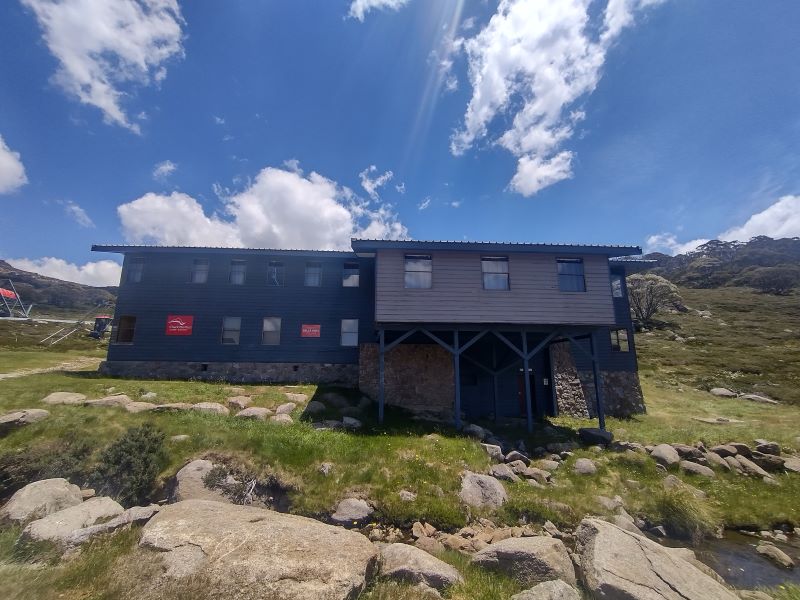
Renovated chairlift station at Charlotte village terminal. Kosciuszko National Park.
The old terminal station at Charlotte village. Now accomodation for village workers.

Building the chairlift was a major engineering feat.  Work started in 1963 on a ‘Sedan’ style chairlift moving 350 skiers per hour in both directions. The sedan seat was enclosed by a fibreglass cupola.

There were high hopes for the popularity of the chairlift which was to glide five kilometres over the freezing roof of Australia. As a bonus, punters could drop in for a feed at the Stilwell/Ramshead Restaurant.  At 2057 metres touted to be the highest in Australia.

Rick Walkon in ‘Skiing off the Roof’ has this description of the chairlift’s history:

‘The chairlift was a disaster from the start. 

The Snow gods wasted no time in showing disdain for the sea level engineers.  With the first snow falls in 1964, a variety of design faults became glaringly obvious… Incessant strong winds on an extremely exposed plateau hit the chairs at right angles, causing them to swing violently and nearly collide with towers.

More often than not, a busload of sightseers complete with high-heeled shoes, cameras and bags ended up dangling in icy winds awaiting rescue.  Inevitably a few passengers fell out of the chairs’.

Apparently, a blizzard started in July 1964 and lasted 31 days. At the time wind gauges registered 180 kph and eventually blew away.  Chairs were ripped from the cables and towers buckled.  More blizzards followed.

Ramshead Restaurant.

Understandably, rumours of frozen corpses arriving at the Top Station did not engender confidence in a ride on the World’s Longest Chairlift. Suffice to say, the chairlift closed after only two seasons.   

For those of you keen about skiing and the history of skiing in Australia and Charlotte Pass in particular, look no further. Rick Walkom’s ‘Skiing off The Roof‘ is jammed packed with facts, anecdotes and hundreds of historical photographs. This book is a treasure.

Rick Walkom ‘Skiing off The Roof.’ 4th edition 2022. Broadcast Books.

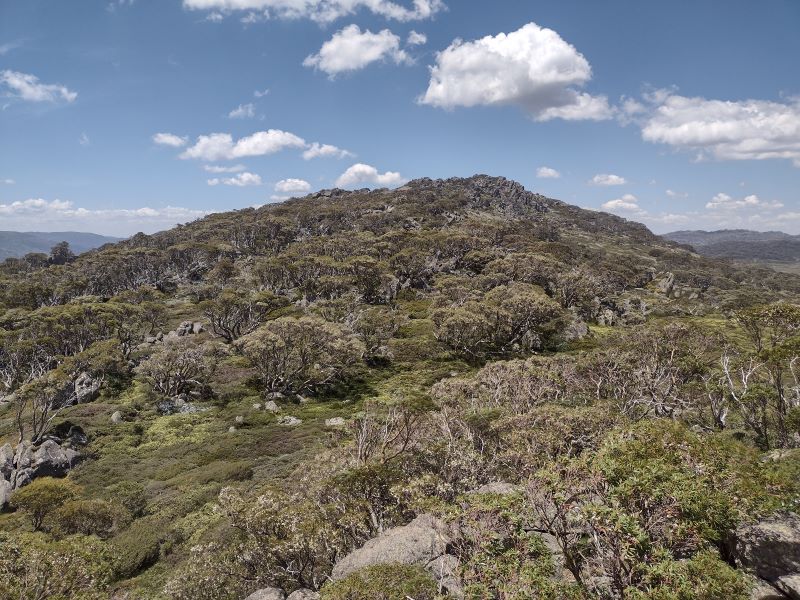
But we were on a different mission.  After a bite to eat, we headed off, travelling south west, paralleling the summit skyline of Kangaroo Ridge on the 2050 metre contour.  What followed was an outstanding alpine walk.  Our route had us crossing alpine meadows and ducking in and out of fields of granodiorite boulders.

Kangaroo Ridge. Kosciuszko National Park
Kangaroo Ridge

Several kilometres along we intersected the soggy headwaters of Merritts Creek.  From here we swung north west, staying high but paralleling Merritts to where it crosses the Summit Track.  This is a section of the Australian Alps Walking Track (AAWT) that joins Rawsons Pass (below Mt Kosciuszko) to Charlotte Pass. 


On the Summit Track. Part of the Australian Alps Walking Track

We had stepped through into a parallel universe.  From the solitude of Kangaroo Ridge we hit the teeming AAWT.  Swarms of hikers and mountain bikers bustling along. All intent on summitting Mt Kosciuszko, at 2029 metres Australia’s highest mountain.  

A short trot took us across Merritts and then the mighty Snowy River.  We stood a mere two kilometres from its topmost seepages.
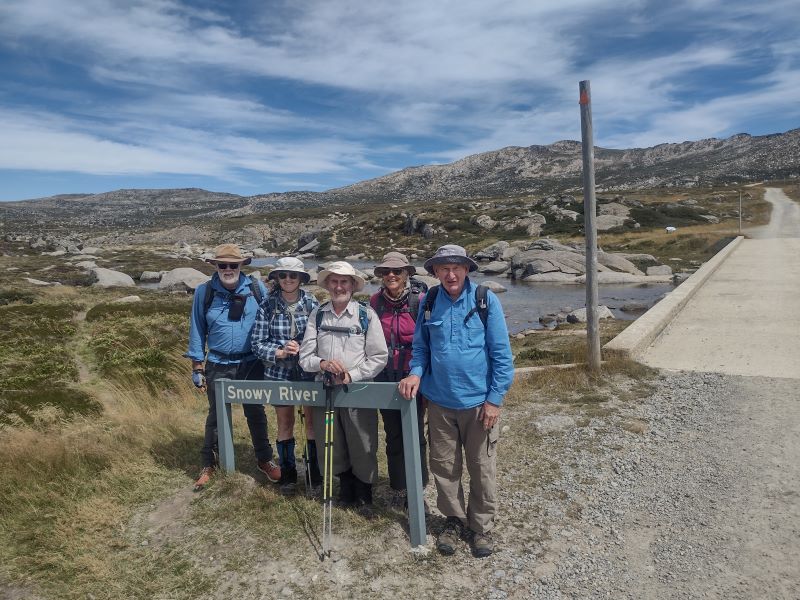
Snowy River crossing on Summit Track
Snowy River crossing on Summit Track. Australian Alpine Walking Track
Upper Snowy River headwaters. Kosciuszko National Park
Headwaters of Snowy River above the Australian Alps Walking Tack crossing
Seamans Hut

From the Snowy, the AAWT climbs up a steep pinch onto Etheridge Ridge and Seamans Hut. 
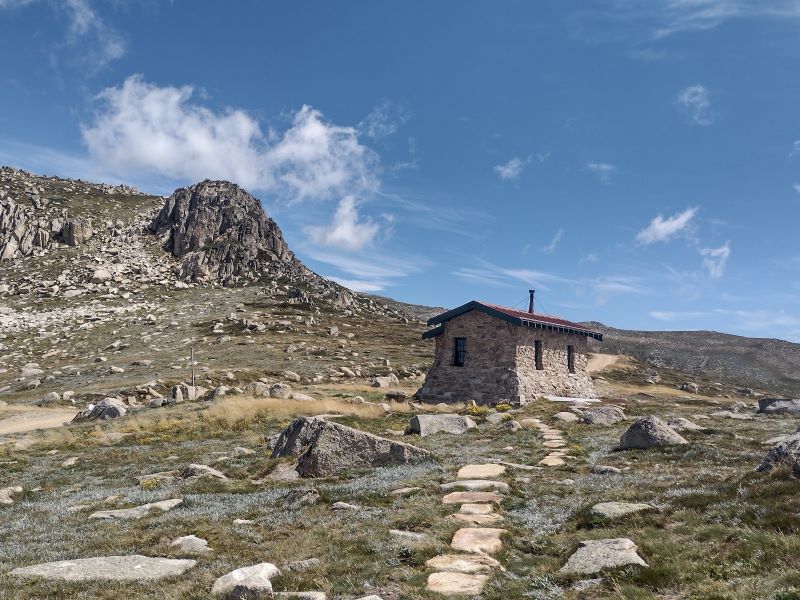
Seamans Hut with Etheridge Ridge in background. Kosciuszko National Park.
Seamans Hut with Etheridge Ridge in background.

Seamans is a nifty stone shelter on the Summit Trail below Rawsons Pass.  The 7m X 3m granite stone hut was originally named the Laurie Seaman Memorial Chalet.  A bit of a mouthful, so now is universally known as Seamans.

Seamans Hut. Summit Track. Kosciuszko National Park.
Seamans Hut

It was constructed in 1929 to commemorate W. Laurie Seaman who perished in a blizzard with his fellow skier, Evan Hayes. Seaman’s body was found leaning against a rock near the present site of the hut. 

The two skiers had departed under blue skies but got caught in an afternoon blizzard while skiing off the summit of Kosciuszko.  The men separated and Hayes’ body was found above Lake Cootapatamba.  Lying on his skis. A cairn of stones marks the spot. He was found about one kilometre north of the hut on the side of Mt Kosciuszko. 

Lake Cootapatamba. Kosciuszko National Park
Lake Cootapatamba. A benign summer’s day.

An emergency shelter was built near Lake Cootapatamba c 1952 as an emergency hut for Snowy Mountains Authority Hydrologists on Cootapatamba Creek for a proposed diversion of its waters via aqueducts and tunnels to the Kosciuszko Reservoir on Spencers Creek. The Koscuiszko Reservoir proposal was abandoned in about 1965.

Cootapatamba emergency hut. Mid winter. Kosciuszko National Park.
Cootapatamba emergency hut. Mid winter. The ‘chimney’ is to allow entry into the hut during winter.

Seaman’s camera was retrieved and the processed photographs showed them standing next to Kosciuszko’s summit cairn.

Laurie’s parents travelled from the USA to visit the site where their son was found.  They contributed 150 pounds to build a memorial shelter. The full story of the tragedy can be read in Nick Brodie’s ‘Kosciuszko’.

The hut now serves as an emergency shelter for skiers and bushwalkers caught out in Kosciuszko’s fickle alpine weather.


We ducked into Seamans for lunch and to dodge the westerlies that had been plaguing us all week.  A quick bite, a gander at the hut’s log book and info board and we were off again. With the whiff of the finish line in the air, Chris, Neralie and Garry loped off, leaving Joe and I to wend our way back, at a pace more suitable for elderly gentlemen. A mere six kilometres downhill.


We fell in with happy throngs of summiteers.  These ranged from two young turks who had just completed a 10 peaks challenge to a very stylish hiking couple. The latter, still to summit, were heading uphill at 2.30 pm, untrammeled by the weight of the basics like waterbottles, backpacks, rain gear and spare warm gear. Just Hokas, sunnies and light-weight outdoor apparel to speed them on their way to a sunset viewing from Kosciuszko summit. See photo below.

Storm clouds brewing over the Main Range late afternoon
The Ten Peaks Challenge

I hadn’t heard about this 10 peaks lark, but I discovered later that it is a 64 plus kilometre peak bagging ‘challenge’ involving ascents of the highest Main Range peaks over a 24 hour period.

All of which I had climbed with bushwalking companions over the decades, but certainly not in 24 hours. Commmercial operators offer two/three/four day packages if you are not confident about this alpine stuff. Our two young friends being made of sterner stuff, had completed the feat over a weekend.  


Joe and I gladly soaked up the easier downhill pace and the enjoyment of extensive views down the Snowy River Valley far below us.

So ended another brilliant day out and about in Australia’s Snowy Mountains with my fellow Kosciuszkians Joe, Neralie, Garry and Chris. Mt Stilwell is a short walk but if you look around, there is much to interest even the casual hiker.
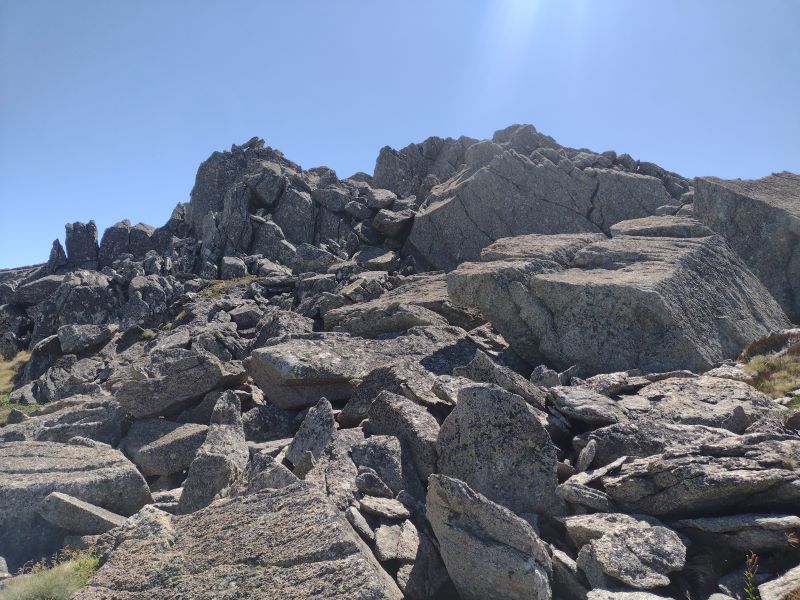
Little Stilwell. Kosciuszko National Park.
Much more to explore. Little Stilwell.

 More Kosciuszko hikes for your delectation

Snowies Alpine Walk: A Scenic Walk from Charlotte Pass to Guthega Village via Illawong Hut.

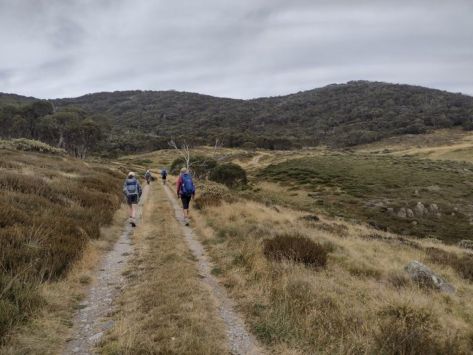
After our previous day’s walking on the Snowies Alpine Walk from Charlotte Pass Village to Perisher via Porcupine Rocks, we were keen to check out another new section. This time we settled on the new nine kilometre walk from Charlotte Pass to Guthega village. A top day beckoned. Clear skies, maximums hovering around 21o C and an alpine ramble with my walking friends Joe, Chris, Neralie and Garry.

by Glenn Burns

Snowy River. Kosciuszko National Park
Snowy River. Downstream of Charlotte Pass.
The BOM had issued a heatwave warning in its Snowy Mountains forecast. But for this quintet of Queenslanders the threatened 21o C maximum was just so. Not too hot, not too cold.


In 2018 construction started on the Snowies Alpine Walk. The NSW Government boasted it would deliver ‘ a world-class, multi-day walk across the alpine roof of Australia in Kosciuszko National Park.’

This 55 kilometre, 4 day walk, on Ngarigo Country, connects the existing Mt Kosciuszko-Main Range walk with three new sections. Namely, Charlotte Pass to Guthega Village; Charlotte Pass Village to Perisher Village via Porcupine Rocks and, as of 2024, the still incomplete section from Perisher Village to Bullocks Flat in the Thredbo River Valley.

Snowy River from the Snowies Alpine Track. Kosciuszko National Park.
Snowy River from the Snowies Alpine Walk track.

After a top day of alpine walking yesterday from Charlotte Pass to Perisher, life on the track was on the up and up. An uneventful drive, with Joe at the wheel, from our digs at Sawpit Creek, delivered us to Charlotte Pass (1840 m).

Bang into an unexpectedly biting wind. Someone had neglected to clock the forecasted 50 kph wind gusts. So with the wind chill effect, the ambient temperature was pretty cold. And this was mid-summer, Australia. As my old walking pal Brian was apt to say: ‘strong enough to blow a brown dog off its chain’. We pulled on an extra layer.

Charlotte Pass on a windy day

Pleistocene Glaciation in Kosciuszko National Park

If you had been standing at this very spot some 60,000 years ago, in the frozen depths of the last Pleistocene ice age, the scene in front of you would have been vastly different.

You would have gazed across a panorama of snow and ice. Rivers of ice poured out from ice-filled glacial bowls on the south east flanks of Mt Lee, Mt Clarke, Carruthers Peak, and Mt Twynam. The current valleys of Club Lake Creek, Blue Lake Creek, Twynam Creek would be brimming with glacial ice grinding bedrock to a pulp on its way to join the major valley glacier in the Snowy River.

In fact, it is possible that your perch at Charlotte Pass would have been covered by a mass of abrading Snowy River glacial ice pushing over this interfluve into the neighbouring Spencers Creek valley. Or so some geologists hypothesise.

Back then temperatures would have been much colder. The minimum temperature today was 12o C. 17,000 years ago it would have been at least 5 to 8o C lower.

In Kosciuszko there is evidence of at least two distinct glaciations. The Early and Late Kosciuszko glaciations. The Early Kosciuszko Glaciation consisted of a single major advance at approximately 60, 000 years ago called the Snowy River Advance. This was the most extensive advance with later advances less extensive.

Geologists tell us that the Snowy River glacier probably extended as far downstream as Illawong Hut. Possibly further. There is evidence of glacial debris downsteam at Island Bend, discovered during surveys for the Snowy Mountain Scheme.

The Late Kosciuszko glaciation consisted of three smaller glacier advances, starting about 32,00 years ago: Hedley Tarn Advance (32,000 years ago), Blue Lake Advance (19,000 years ago) and Mt Twynam Advance (17,000 years ago).

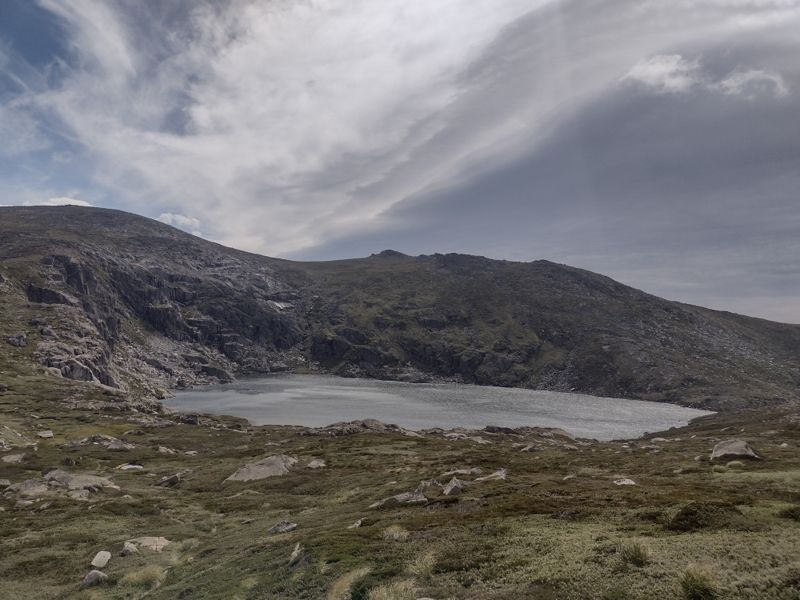
Blue Lake cirque. Kosciuszko National Park.
Blue Lake cirque under Mt Twynam.

The systematic search for evidence of glaciation in Kosciuszko got seriously under way in 1901. A scientific party of Professor T.W. Edgeworth David (geologist), Richard Helms (zoologist and botanist), E.F. Pittman , and F.B. Guthrie (Professor of Chemistry) found incontrovertible evidence of the action of glacial erosion and deposition:

Early Geology Map of Kosciuszko’s Main Range by T.W.Edgeworth David.
Club Lake. Kosciuszko National Park.
Club Lake. A moraine dammed lake.

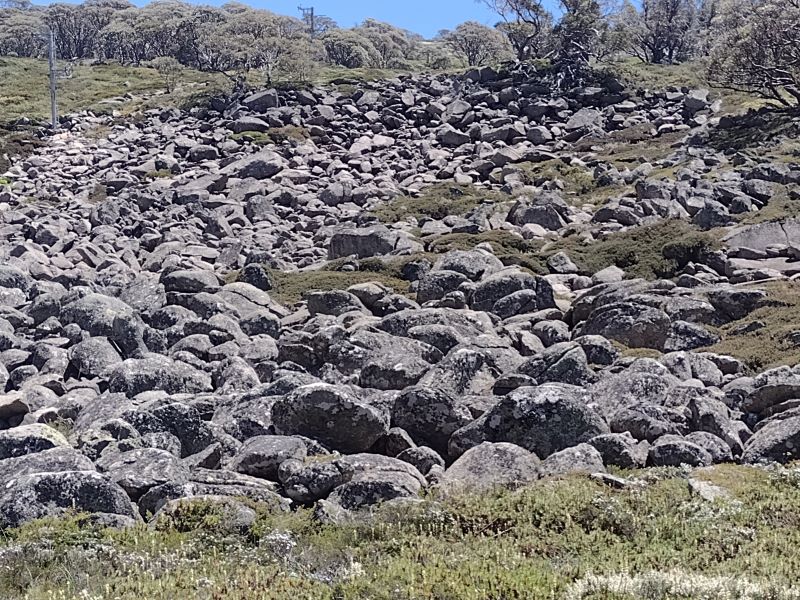
The Kosciuszko Plateau has been now been free of of glaciers for about 15,000 years. In addition to the glacial landforms mentioned above, the observant bushwalker can find ample evidence of periglacial landforms over much of the higher country. Some easily identified of these landforms include blockstreams, solifluction terraces and thermokarst ponds.

Block stream Spencers Ck. Kosciuszko National Park
Periglacial landform. Block stream. Spencers Creek.

Meanwhile, back in the Anthropocene, the Snowies Alpine Walk (SAW) from Charlotte Pass initially heads downhill on the paved NPWS vehicular track towards the Snowy River. Some 500 metres of descent will deliver you to a junction and noticeboard trumpeting the start of the walk to Guthega village. We executed a hard right onto the SAW path.

Signage on Snowies Alpine Walk. Kosciuszko National Park.
SAW signage at junction to Guthega. Track over Snowy River to Main Range in background.
Map of Snowies Alpine Walk: Charlotte Pass to Guthega Village.
Map of Snowies Alpine Walk. Charlotte Pass to Guthega section. Kosciuszko National Park.

Here the SAW parallels the Snowy River on its eastern bank, winding around Guthrie Ridge on the 1700 m contour before dropping to Spencers Creek and the Snowy River at Illawong Hut. The final part of the day’s walk picks up the old Illawong-Guthega bushwalker’s pad to fetch up at Guthega Village, some nine kilometres from Charlotte Pass.


Back in the Day… 2009… Guthrie Ridge.

But, back in the day, in 2009, a 17 kilometre walk from our camp on Strzelecki Creek under The Sentinel to Charlotte Pass thence to Illawong Hut via Guthrie Ridge was more of a challenge. We set off with a brilliant off-track alpine ramble from Strzelecki Creek to Charlotte Pass via Carruthers Peak, Mt Northcote, Mt Clarke and the Snowy River Crossing.

Mt Clarke. Kosciuszko National Park.
Mt Clarke and Snowy River Valley.

Once at Charlotte Pass we swung off-track again to climb Mt Guthrie (1920 m). The usual suspect had cooked up this feral route that followed the spine of Guthrie Ridge (1900 m) and then descended to an overnight bivvi at the junction of Twynam Creek and the Snowy River. Close to Illawong Hut.

Mt Guthrie. Kosciuszko National Park
Mt Guthrie and Guthrie Ridge

Mt Guthrie and Guthrie Ridge were named by Richard Helms for his friend F.B. Guthrie, Professor of Chemistry.

My peak bagging companion had hinted at another exceptional alpine stroll to cap off what had been, so far, a matchless day of hiking. A mere two and a half kilometres or a one hour leisurely amble along the spine of Guthrie Ridge would deliver us to our campsite on the junction of Snowy River and Twynam Creek. Fun times.

Mid afternoon, on a steep mountainside, high above the valley floor three beleaguered peak baggers pushed wearily through the tangle of granite boulders and scratchy mountain peppers, Kunzeas, Epacris and snow gums that lay between them and the day’s end. Route wise, a bad call.

Gutherie Ridge. Kosciuszko National Park.
Tangle of boulders and vegetation. Guthrie Ridge.

But I was resigned to this stuff. Situation normal when walking with my bush-bashing, peak bagging buddy Brian. He claimed it was just the price we had to pay for a very satisfying and bludgy morning’s walk. Finally, we staggered in just on dusk. The campsite made it all worthwhile. We set up on a springy snow grass ledge… lulled to sleep by the riffling Snowy River. All was well in my little slice of bushwalking paradise and all is forgiven Brian.


The new Snowies Alpine Walk.

After mulling over this previous cross country experience I gave thanks for the newly minted super SAW highway. Cortan steel elevated boardwalks, rock-armoured track surfaces and dry boots compliments of a high suspension bridge over Spencers Creek. A speedier passage than taking that infernal high road along Guthrie Ridge. But nowhere near as interesting.

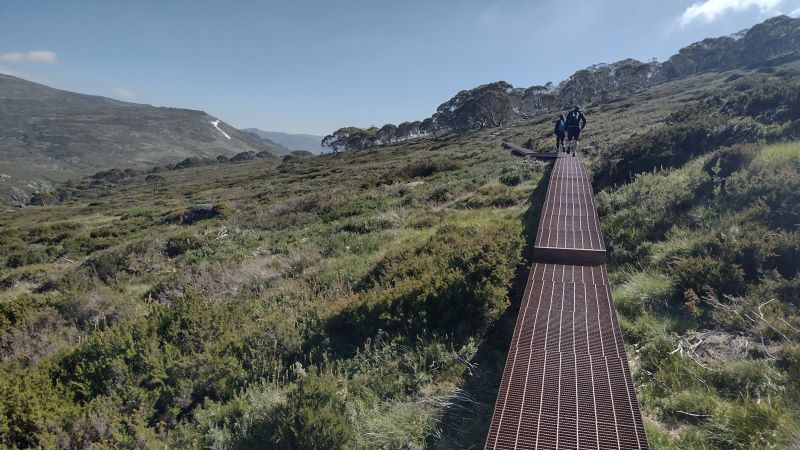
The track took us initially over another of those eyesore Cortan steel boardwalks much favoured in Kosciuszko National Park. But I admit they do an excellent job of protecting the low heath and snow grasses below.

Snowies Alpine Walk. Kosciuszko National Park.
Snowies Alpine Walk. Cortan steel boardwalk over low heath.

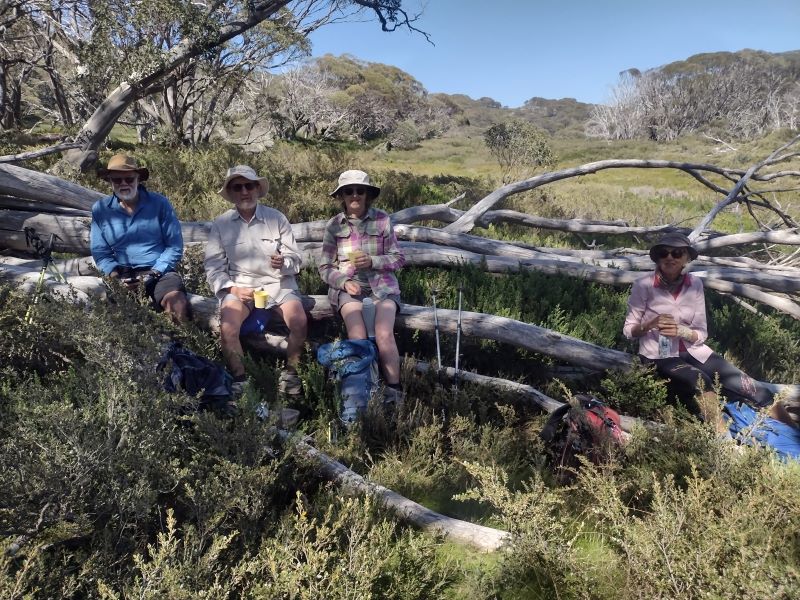
Eventually the track leaves the low heath and climbs on its granite pavement ever upward through snow gum woodland. As did Garry. Left us, that is. We found him, as I expected, propped on a log in a bower of snow gums. The ideal morning tea stop.

Morning tea stop. Snow gum woodland

Snow gum woodland, invariably, is clothed in a dense scrubby understorey of beastly spikey undergrowth like Bossiaea, Epacris, Hakea, Grevillea, Oxylobium, and Kunzea . Here’s where those weird knee-length canvas gaiter things worn by Australian bushwalkers are a brilliant piece of kit.

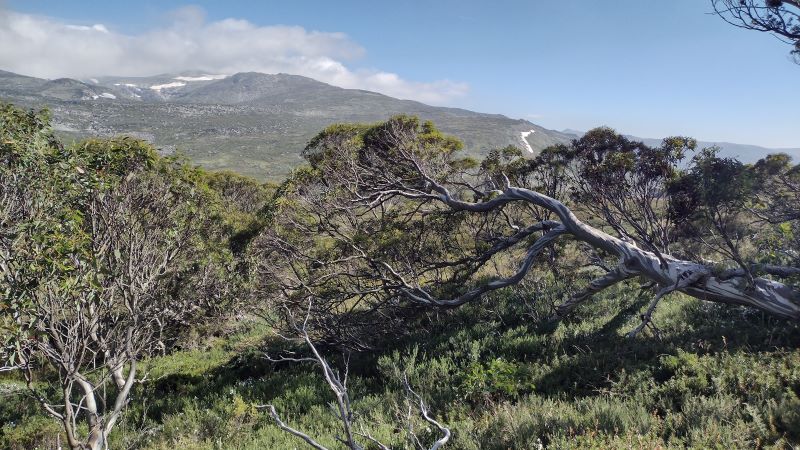
The low growing snow gum woodland is found above 1500 metres and is dominated by snow gums or white sallee ( Eucalyptus pauciflora).

Snow gums. Eucalyptus pauciflora. Kosciuszko National Park.
Snow gums (Eucalyptus pauciflora). Gnarled and wind shorn.

The snow gum zone is found extending down to the lower levels of winter snowfall and is the only tree to grow above 1500 metres. Above this woodland zone the landscape transitions suddenly into the true alpine zone of heathland, grassland and bogs.

Snow gum Woodland. Kosciuszko National Park.
Snow gum woodland with scrubby understorey of Bossiaea, Kunzea, Hakea, Oxylobium.

The undergrowth is called heath and can be waist-high with tough whippy branches to withstand the weight of snow (and, hopefully, bushwalkers) without breaking. Throw in the odd torpid highland copperhead and pit-fall traps of wombat and bunny burrows and hiking through this scrub quickly losses its appeal.

Fortunately, the new super SAW highway saved us from having to thrash through that stuff.


Much of the SAW walk parallels the Snowy River which flows NNE downstream towards Guthega Pondage. It is joined on its western bank by the south east flowing drainage lines of Blue Lake Creek, Twynams Creek and Pounds Creek.

These creeks have their headwaters along the highest parts of Australia’s Great Dividing Range: Carruthers Peak (2010 m), Mt Twynam (2196 m), Mt Anton ( 2010 m) and Mt Anderson (1997 m). The Main Range peaks all visible from this section of the SAW.

Today’s walk provided expansive and unimpeded views down the nearly straight Snowy River Valley. Its side slopes planed back by late Pleistocene valley glaciers. Glacial valleys all over the world typically exhibit these truncated spurs and U shaped valleys.

Glacially abraded Valley slopes. Snowy River. Kosciuszko National Park.
Glacially abraded valley slopes. Snowy River.

Some 4.5 kilometres after the track entrance our path left the snow gum woodland and descended across low heath covering a gently rounded spur at the intersection of the Snowy River and Spencers Creek. An abraded spur, ground down during the Pleistocene by the Snowy River and Spencers Creek valley glaciers.

Snow gum woodland. Kosciuszko National Park.
Snow gum woodland on the Snowies Alpine Track.

Joe and I caught up Chris and Neralie just short of the Spencers Creek suspension bridge. They were magging with two walkers travelling in the reverse direction. Uphill to Charlotte Pass. I’m not sure of the rationale for doing this section uphill, but many people do. Meanwhile, Garry was last seen as a distant speck beetling toward Illawong Hut.

The SAW track builders had thoughtfully provided a nifty suspension bridge consisting of a steel mesh plank and handrails to usher walkers safely across Spencers Creek. Built in 2021 it is said to be, in terms of its location, at 1627 metres of altitude, the highest suspension bridge in Australia .

Suspension Bridge over Spencers Creek. Kosciuszko National Park.
Suspension Bridge over Spencers Creek

Meanwhile Garry had escaped the wind by taking refuge at the side of the hut. Just don’t turn up here in a serious blizzard. You will find the inn door locked, as we did. An unusual arrangement for high country shelters. But this is because Illawong is the only private lodge outside the main ski resorts.

Illawong Hut. Kosciuszko National Park.
Illawong Hut.

But, to be fair, the illustrous Illawong Ski Tourers have thoughtfully provided a sealed crawl space for midgets under the hut for just such an emergency. And, they have thrown in as a goodwill gesture, a snow shovel to dig yourself out or in. Once out of your blizzard, don’t try to sit up. The upside is that you are safe and don’t have to share the under floor space with assorted snakes, wombats and other creepy-crawlies.

Emergency shelter. Illawong Lodge. Kosciuszko National Park.
Emergency Shelter at Illawong Hut.

Illawong Hut

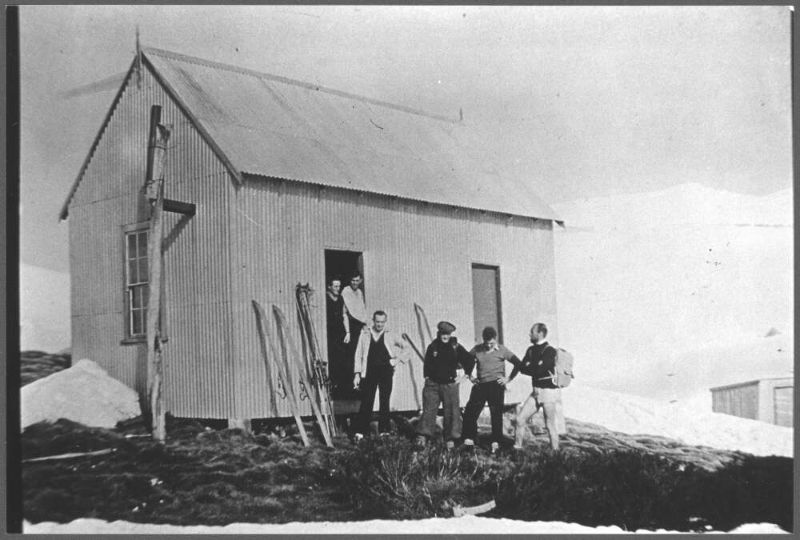
Illawong, also known as Pounds Creek Hut and Tin Hut No1, was constructed in the summer of 1926-1927 as a shelter hut. Illawong is said to mean ‘view of the water’. A basic two roomer/four bunks, it was built by the NSW Tourist Board to assist Dr Herbert Schlink in his first Kiandra to Kosciuszko ski crossing during the winter of 1927.

Pounds Creek Hut, now Illawong Hut in 1940s. Kosciuszko National Park.
Pounds Creek Hut ( now Illawong Lodge) in 1940s. Source: NLA: obj-147481686

After construction it was used for early ski touring, summer bushwalking and by mountain cattlemen. At the time only two other buildings existed in the high country: Betts Camp and Kosciusko Hotel.

In 1955, John Turner of the Ski Tourers Association brewed up a plan to convert Pounds Creek Hut into a ski lodge. A year later, in 1956, the Kosciuszko State Trust gave permission for the hut to be extended to become a private ski lodge managed by Illawong Ski Tourers.

The conversion was a bit of mission for lodge members. No helicopter lifts in those days. All materials and food supplies had to carried in. Though some ingenious work-arounds were dreamt up. Klaus Hueneke in his first-rate tome: Huts of the High Country provides this description:

” Over the next two years members, friends and passersby spent endless summer days and occasional premature wintry ones carrying, rowing, pushing and dragging materials to site. “

And this:

” Rowing the materials up Guthega Dam was a new twist to mountain transportation and not without incident… boat trips took on ice floes, wind driven sleet and polar wombats! The final leg was considerably aided by a sled and the muscle power of Mick, a horse from the Chalet. Unfortunately he had only two speeds – stop and run like hell. “

Those enterprising Illawongians weren’t finished yet. Over the years the Lodge was spruced up with a septic tank, electric lighting, a gas cooker, a refrigerator, a hot water service, decent mattresses, carpets and a phone. A veritable home away from home. My membership application is in the mail.

Members also designed and built the flying fox over Farm Creek and the suspension bridge over the often raging Snowy River. For this latter feat all skiers and bushwalkers wanting to access the Main Range should give them fulsome thanks. Two earlier bridges had been swept away before a decent one was installed in 1971. The final version was designed and built by one Tim Lamble and assembled with the help of the NPWS helicopter.

Tim, incidently, is also the author of my favourite piece of cartographic art: the Mt Jagungal and The Brassy Mountains 1:31680 map.

Extract of Tim Lambles map of Mt Jagungal and Brassy Mountains. Kosciuszko National Park.
Extract from Tim Lamble’s map Mt Jagungal and The Brassy Mountains. 1:31680.

Illawong Hut has been placed on the National Heritage Register, the National Trust (NSW) Register and NPWS Historic Places Register. Its NPWS citation reads:

” Illawong Hut is one of the most historically significant huts in the park, being a rare remnant of early 20th century NSW Government Tourist Bureau efforts to promote alpine tourist recreational activities.”

For good measure the Farm Creek flying fox and the Snowy River suspension bridge are also on the register.

Snowy River suspension bridge. Kosciuszko National Park.
Snowy River suspension bridge accessing The Main Range.

With little over two kilometres to Guthega my friends had scarpered in a cloud of dust. The upgraded SAW track follows the old bushwalking pad between Illawong and Guthega. It skirts around the southern bank of Guthega Pondage. This pondage, a tunnel and Guthega (Munyang) hydro power station were built as part of the Snowy Mountains Scheme in the early 1950s.

This Munyang (Guthega) project area is the start of many of my favourite walks in Kosciuszko.

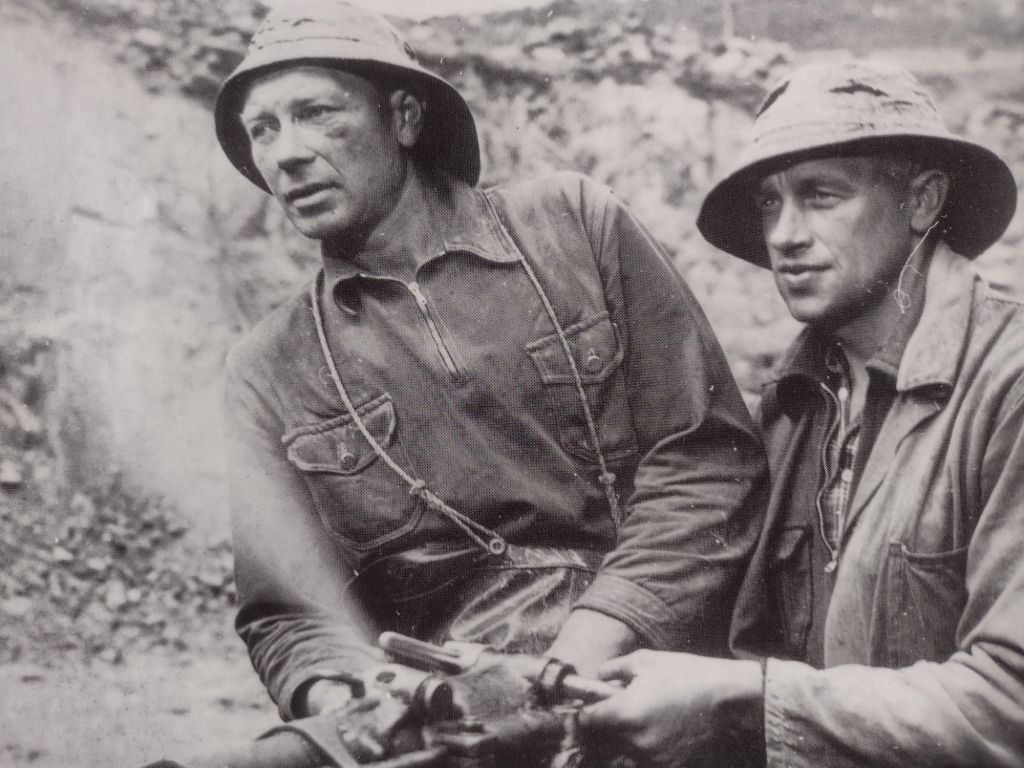
And it is also the start of the first major project of the Snowy Mountains Scheme in 1951. The tender was awarded to a Norwegian firm, Ingenior F. Selmer. A serious player in global dam and hydro construction. The bulk of the workers were Norwegians (450, mainly labourers) from the rural areas of the Arctic Circle.

Norwegians working on Snowy Mountains Scheme.

On the 21 February 1955 , only a few weeks behind schedule, electricity flowed from Munyang.

Historical photo of Munyang Power Station. Kosciuszko National Park.
Munyang (Guthega) Power Station under construction. Circa 1950.

The word Munyang or Muniong derives from local aboriginal people. When camped on the Eucumbene Valley, they would point to the snow covered Main Range and repeat the word ‘Munyang’ or ‘Muniong’ . Said to mean ‘big’ or ‘high mountain’. Also ‘big white mountain’.

If you want to read more about the fascinating people and places of the Snowy Mountains Scheme, I can highly recommend Siobhan McHugh’s: ‘The Snowy, a History.

Book. The Snowy. Siobhan McHugh
Siobhan McHugh: The Snowy, a History. Anniversary Edition. NewSouth Publishing. 2019.

Nearing the end of our walk, the SAW crosses Farm Creek via a metal bridge then climbs to Guthega Village. No need to risk life and limb on the the rusty old flying fox still there. Fortunately, it has been padlocked by some kill-joy to discourage thrill seekers like my walking companions.

Farm Creek bridge on SAW. Kosciuszko National Park.
Farm Creek bridge on SAW.

At the still to be completed track exit, rangers were busy fiddling around sorting out signage. Here we had views over the waters of Guthega Pondage, the dam wall and the intake for the tunnel to the top of the Munyang penstocks.

Guthega Pondage. Kosciuszko National Park.
Approaching Guthega Pondage along SAW track.
Final construction work at lookout on track exit at Guthega.

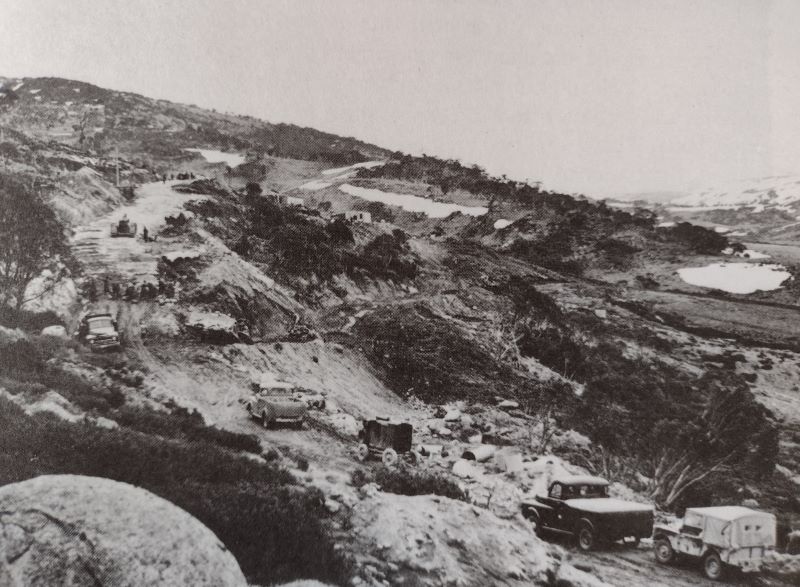
Guthega village did not exist before 1950. The only building in the area was our old friend Illawong Hut. In 1951 when the Norwegian company Selmer started construction on the first major project of the Snowy Mountains Scheme , their construction camp became known as ‘Little Norway’ as it housed the largest number of Norwegians living outside of Norway at the time.

Historical Photo of road to Guthega. 1950.Kosciuszko National Park.
Road to Guthega still under construction 1950.

When Selmer returned to Norway in 1954, at the end of their contract, they took most of their construction camp with them, leaving just three huts. These huts kick-started the modern day Guthega Ski Resort.

Huts left by Selmer at Guthega. Source: Perisher Museum.

The huts were scooped up for peanuts in 1955 by SMA Cooma Ski Club, YMCA Canberra Ski Club and Sydney University Ski Club. The village now sports private lodges, a restaurant and bar, commercial resort accommodation and various tow knick-knacks to ferry skiers to the top of their runs.

Guthega serves as a winter base for downhill skiing, cross country skiers, snow-shoers and snow-boarders. The alpha adventurers head for Blue Lake to try out their ice climbing skills. But in summer, Guthega is pretty much dead. A ghost resort. Hopefully, this will change given the number of walkers I saw on the track.


It was now two hours past our lunch hour. A familiar pattern developing here, much to the chagrin of my fellow walkers. We found Garry’s vehicle, wheels still attached, piled in and headed for nearby Island Bend Campground on the Snowy River for a belated feed.

The campground was once the site of a construction village for the Snowy Mountains Scheme.

Historical photo of Island Bend Barracks. Kosciuszko National Park.
Island Bend Barracks. Snowy Mountains Scheme.

We ducked into a pleasant little nook with a picnic table and some soft grass for a post-prandial kip. All in all, a top day of alpine hiking with my walking companions, Joe, Chris, Neralie and Garry.

Happy Hikers.

I had many more days of alpine adventures for my fellow Kosciuszkians. God bless their little walking boots. Maybe not so little.


Check out these Kosciuszko walks.